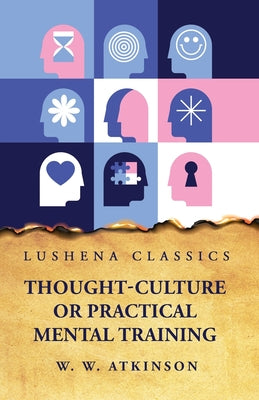
By William Walker Atkinson
What is thought? The answer is not an easy one although we use the term familiarly almost every hour of our waking existence. The dictionaries define the term "Thought" as follows: "The act of thinking; the exercise of the mind in any way except sense and perception; serious consideration; deliberation; reflection; the power or faculty of thinking; the mental faculty of the mind; etc." This drives us back upon the term "to think" which is defined as follows: "To occupy the mind on some subject; to have ideas; to revolve ideas in the mind; to cogitate; to reason; to exercise the power of thought; to have a succession of ideas or mental states; to perform any mental operation whether of apprehension judgment or illation; to judge; to form a conclusion to determine; etc." Thought is an operation of the intellect. The intellect is: "that faculty of the human soul or mind by which it receives or comprehends the ideas communicated to it by the senses or by perception or other means as distinguished from the power to feel and to will; the power or faculty to perceive objects in their relations; the power to judge and comprehend; also the capacity for higher forms of knowledge as distinguished from the power to perceive and imagine." When we say what we "think " we mean that we exercise the faculties whereby we compare and contrast certain things with other things observing and noting their points of difference and agreement then classifying them in accordance with these observed agreements and differences. In thinking we tend to classify the multitude of impressions received from the outside world arranging thousands of objects into one general class and other thousands into other general classes and then sub-dividing these classes until finally we have found mental pigeon-holes for every conceivable idea or impression. We then begin to make inferences and deductions regarding these ideas or impressions working from the known to the unknown from particulars to generalities or from generalities to particulars as the case may be. It is this faculty or power of thought-this use of the intellect that has brought man to his present high position in the world of living things. In his early days man was a much weaker animal than those with whom he was brought into contact. The tigers lions bears mammoths and other ferocious beasts were much stronger fiercer and fleeter than man and he was placed in a position so lacking of apparent equal chance of survival that an observer would have unhesitatingly advanced the opinion that this weak feeble slow animal must soon surely perish in the struggle for existence and that the "survival of the fittest" would soon cause him to vanish from the scene of the world's activities. And so it would have been had he possessed no equipment other than those of the other animals; viz. strength natural weapons and speed. And yet man not only survived in spite of these disadvantages but he has actually conquered mastered and enslaved these other animals which seemed likely to work his destruction. Why? How? This feeble animal called man had within him the elements of a new power-a power manifested in but a slight degree in the other animals. He possessed an intellect by which he was able to deduce compare infer-reason. CONTENTS I. The Power of Thought II. The Nature of Thought III. Phases of Thought IV. Thought Culture V. Attention VI. Perception VII. Representation III. Abstraction IX. Association of Ideas X. Generalization XI. Judgment XII. Derived Judgments XIII. Reasoning XIV. Constructive Imagination
For all orders exceeding a value of 100USD shipping is offered for free.
Returns will be accepted for up to 10 days of Customer’s receipt or tracking number on unworn items. You, as a Customer, are obliged to inform us via email before you return the item.
Otherwise, standard shipping charges apply. Check out our delivery Terms & Conditions for more details.
Returns will be accepted for up to 10 days of Customer’s receipt or tracking number on unworn items. You, as a Customer, are obliged to inform us via email before you return the item, only in the case of:
– Received the wrong item.
– Item arrived not as expected (ie. damaged packaging).
– Item had defects.
– Over delivery time.
– The shipper does not allow the goods to be inspected before payment.
The returned product(s) must be in the original packaging, safety wrapped, undamaged and unworn. This means that the item(s) must be safely packed in a carton box for protection during transport, possibly the same carton used to ship to you as a customer.